
Darryl Rahn is Reintroducing Himself
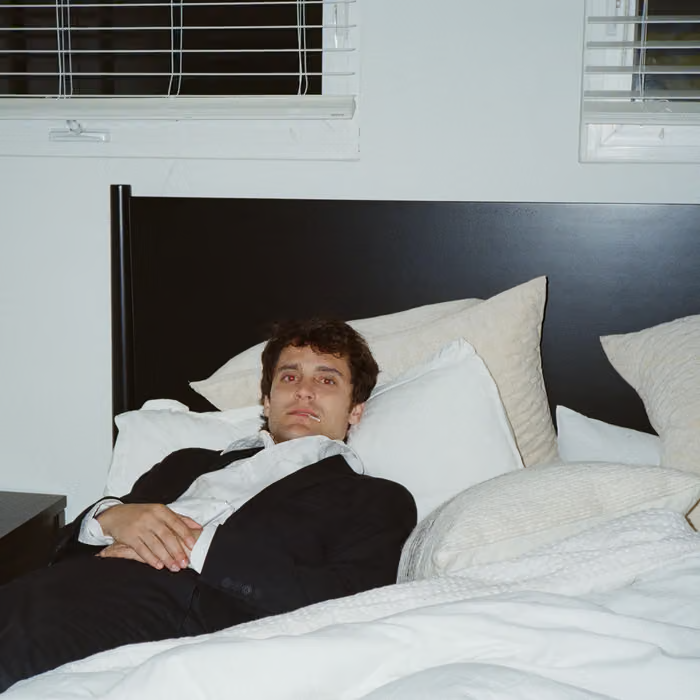
Darryl, released May 29, 2026
New York native indie-folk crooner Darryl Rahn is coming off the release of his latest project, Darryl, and a trio of headline shows in the UK. He was kind enough to chat with me about all things new music, his evolving creative process, and what’s coming next.
TMB: I wanted to talk to you about the shows you just played across the pond. How did it feel to perform the new stuff live?
DR: It felt really good. I was going into it fully prepared to be playing to no one, I had no idea what to expect. And that wasn't the case, which was awesome. It felt really cool to play for people that I know I've truly never played to before. The quote unquote new stuff, I'm kind of already so sick of it, just because I worked on it for so long. It was a nice reminder that there's a lot of people that have no idea what this is or have never heard it. So that was helpful. I was playing solo; there's no backup if something goes wrong. It's just my fault.
TMB: There's nowhere to hide.
DR: Yeah, there's nowhere to hide. The first two shows were totally fine. In Bristol, my brain finally started to melt a little bit from all the trains and Google maps. I definitely flubbed more chords and lyrics at the Bristol show, but they were pretty forgiving.
TMB: I'm sure. Honestly for me as an audience member when I go to a concert and something like that happens, I kind of like it because not everyone else gets to see that. It’s a unique experience that you only have from seeing that specific live show. Were there any songs that you were most excited to play for an audience off the new record or were there any that you were kind of surprised by the audience's reaction to?
DR: Somebody requested a song called “Right On Time,” which was fun because I wasn't planning on playing that one, and didn't know if anybody had even heard it yet. So that was cool. I was excited to play this song “Bed” just because it's a lot softer and feels a lot simpler than a lot of the other ones on the record. So that was fun, too. And just the fact that anybody even knew “Lake Effect” or “Silent Acknowledgement,” they were singing along and I was like whoa, that's crazy. I was excited to play all of them, but yeah, that was pretty trippy.
TMB: Were these some of the bigger shows you've done?
DR: Room-wise, they're still on the smaller end of what I play but that's totally expected because I'm never over there. The venues were all amazing. The London venue was definitely smaller than the ones I'd play in, like, New York, but it felt just as cool. Honestly, I kind of like the small sweaty rooms as opposed to the bigger clubs sometimes.
TMB: Agreed. So back to the new music, I have a million questions for you. But first, I think it's a cool move when people go the self-titled route. This obviously isn't your first full length album that you're putting out, so what led to that choice?
DR: The main reason I would say is because I made it all in my room. Everything you hear is just me in some way or another, which felt like it lent itself to a self-tile. This is truly just me. Usually there's a band, there's a producer, there's an engineer, there's all these other people making the thing sound the way it does. This time I was really like: This is what I can do when left to my own limitations, this is what you get.
I feel like my last name can sometimes confuse people because it sounds like R-O-N or whatever. So I felt like the first name was such a succinct little packaging of the thing. I came up with that idea a good way into the production process. It started as an EP of five songs last summer. And then I just slowly started thinking, well, maybe I could add this one and this one. Some of the songs just kept coming to me. And then by the end, I landed on nine, which is also just my favorite number from when I used to play baseball for whatever reason. I love the number nine. And so I made it nine songs. This feels like, as me as possible. So I might as well just call it Darryl.
TMB: That was one of my questions. Because nine tracks is a unique choice.
DR: Yeah, actually, it's hard for me. I've always been very particular that it has to be at least 10. But then I look back and some of my favorite albums have been less than that. And it also felt like this album happened kind of by accident because I had finished another one, and that still isn't out. That's a much more proper, 13 song thing. So, I didn't feel the internal worry as much about the amount of tracks. I was just like, this wasn't even supposed to be here really. I can have fun with it and not be so particular. It also felt like a reintroduction to my music. I've been making music for a long time, but I've only recently started to, in my mind, make stuff that I would actually listen to and want to share or promote more, I guess.
I thought, why not make it a self-titled kind of a smaller, like literally 25-26 minute thing? Get people in the door and they'll know pretty quickly if they're in or they're out. It is a weird number, but that's what kind of led me to it.
TMB: You’re getting into exactly my next question, about the solo recording. You recorded it at home?
DR: Yeah, right here (gesturing to the apartment making up the background of his Zoom square).
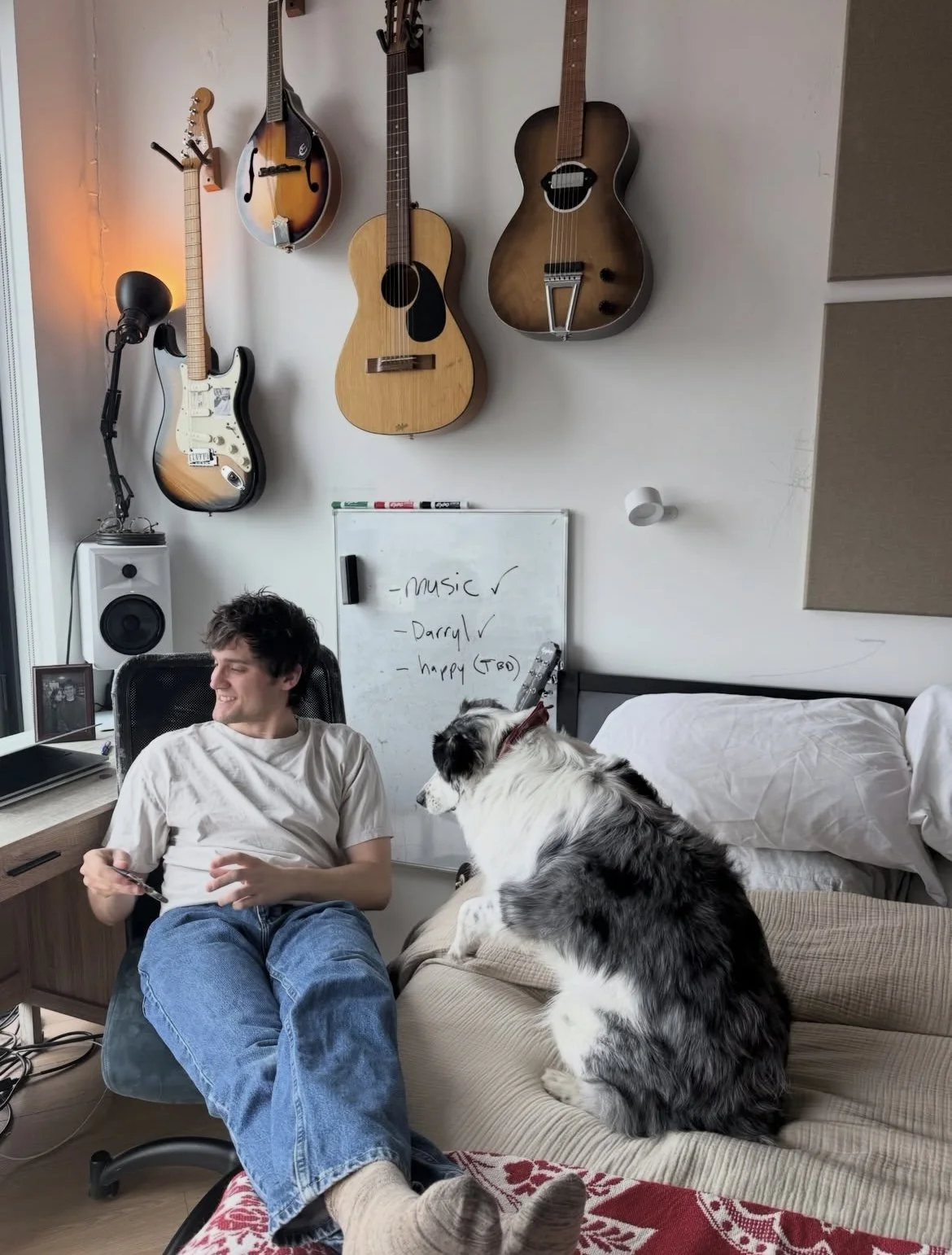
Courtesy of IG// @darrylrahnmusic
TMB: I'm getting a peek into the behind the scenes! First of all, that’s a feat. That's very impressive. I think you can hear on the album too, it sounds a little bit more experimental stylistically than some of the other stuff you've put out. Was that a conscious choice you were making? Or did it happen as a byproduct of the way you made the record, with more freedom in the process of doing it all on your own?
DR: I think working alone and just using what I had allowed me to have more fun, for sure. Not that it wasn't difficult, it was definitely hard sometimes. Having to stop the take and restart and all that stuff gets very draining. But when I was in the zone, I did feel a bit freer because there was no one else in the mix. I had to listen to this stuff so much just recording it. When I'm working with someone else, I go into the studio, I record, and then I wait sometimes days to even get back what we made. Then the reaction time is a little off. This was so immediate where I could pinpoint exact moments, like okay, this is where I'd start to get bored with this song. So what can I do with it?
I had this little keyboard and I started to learn how to make certain sounds with certain plugins. I don't have any fancy synths. I don't have any fancy outboard gear. So it was very much a process of how do I make something sound good with the limited canvas I've got? It was fun to experiment and just be honest with myself throughout the whole process in asking: Is this interesting to me still? I'm going to get sick of it before anybody else, so if I can keep myself interested in each song, then hopefully, you know, that translates.
TMB: Whatever keyboard you learned, it was one of the best uses of a cha-ching sound effect since MIA's “Paper Planes” [In the song Nice N’ Easy].
DR: (Laughs) That was really fun actually. It took a second to get it perfect, matching it up perfectly. The bat and the crowd in that song too, I really liked.
TMB: I loved that. I love when you listen to a song and something a little funky like that sticks out and you're like, wait, what am I hearing? And then you have to play it again.
DR: Yeah. I mean, it's obviously a little silly, but I was also trying to have a story song that had some personality and wasn't sad. I mean, it's not like a happy subject matter, but it's supposed to be more intriguing than it is jarring or sad or anything like that.
TMB: Definitely. So what actually led you to decide to do the record at home, only you? Was it a resources thing or were you like, no, I want to do this this way because of XYZ?
DR: It was a couple of things, but definitely money first and foremost. Like I mentioned before, I had just finished making an album with my band, an engineer and producer. Every time I do that, all the money I have set aside goes to that, and it ends up being so expensive. Honestly more than that, I had reached this point where I was really tired of what I was doing and at my wits end a little bit creatively.
Now, I still actually am super happy with the other album we made, but it just took some time to get back to feeling good about my process. During that time where I was not feeling so good, I just had this deep feeling that I needed to try something different. I'm glad I did because ultimately, I do think in creativity you're only gonna move forward if you are willing to go outside your own process and not get too stuck in your ways. I think A, it hurts yourself to do that, and B, people can sense it. Taking risks is maybe the most important part of creating for everyone involved.
I was at this point where I was really at a loss, and then I stumbled on the riff for the song “Silent Acknowledgement” and it felt like it had a little more personality than a lot of the stuff I had been hammering on. I was excited by that. I was like, okay, at least I can still write a bit. I decided to just make a demo. Then as the demo kept progressing, I actually enjoyed listening to it as if it were not a demo, as if it were a real song. Also, the line between demo and recording in this day and age is so fine, sometimes it doesn't even exist and shouldn't. So, by the time I finished that song, I thought I actually would listen to this and I like it. Once I started sharing it, people seemed to like it too. It felt like, ‘maybe I’m not so off the mark.’ So it inspired me.
Then I thought well, why not follow this process that feels exciting right now and wait to release the other stuff and see what happens. So that's kind of how it went, it came from inside. It was just an intuition of this is what feels good right now. Why not try that instead of torturing myself and doing what I always do, which was burning me out a bit.
TMB: That’s really beautiful. I mean, the “Silent Acknowledgement” guitar riff is so addictive. It's so catchy. I wanted to talk about that song because you had a moment online with it where like you said, people were more responsive to it maybe than some of the other stuff you’ve put out. How did that feel for you to have a little bit of a viral moment on your hands?
DR: I'd say it was like miniature viral (laughs). I mean, it felt good. Obviously, it's always nice to be validated in something you're working on. Having that positive reinforcement, I think, was something that I did need at the time. I was kind of feeling like what I was doing wasn't working. Making a living from music, ultimately, people's response to what you're making does come into play. Not that it should be why you write or why you're in it in the first place. But it was helpful to have that moment of okay, my gut feeling about creating actually is being proven right in terms of the public or people that like the same music as I do.
The main thing is that it enabled me to sell this record to a label which helped me live while I made the rest of it and went on tour. It did kind of feel like I was falling and then I grabbed the last branch and I was like, okay, I'm okay now. I didn't expect any of the other songs to really catch on in that way, just because that song had such a specific personality. My hope is that the song can still get people in the door and maybe get them to some of the stuff that takes a little bit longer to chew on and isn't so immediately accessible.
TMB: Yeah, definitely. I mean, when you see something online where you're like, oh, this is a cool sound, and then you go and there's only one song it's a little bit of a disappointment. It's such a treasure trove when there's a ton of stuff to then get to dig into.
DR: Totally.
TMB: Still on the “Silent Acknowledgement” track, I think making music videos is becoming a lost art. So I loved the music video. I thought it was super cool you put one out. Why was making a video for that song important and how did the concept come to life?
DR: I can't take too much credit for that because the director, Anna Cappello, was really spearheading a lot of it. She had an initial idea and then I thought it should be a little goofier, so that's where the snowman of it all came in. Anna came up with it pretty quickly and was able to assemble a team and a storyboard and figured out all the logistics. We ended up going to my parents' house in my hometown. That's where we shot the whole thing, which was also easier for me because I knew everywhere that would be accessible to shoot and we wouldn't have to do a ton of scouting or permission getting. It was freezing out, so that was tough.
The budget I had from this label helped to make it because music videos are also the most expensive things, there's no way around it. Even if you're making a low budget thing, when you’re one person, it's still high budget. I also had a manager at the time, and he was very adamant that this song needed a video. I'm always reluctant to make videos, just because I feel like it should only be done if it's super in the budget, and if a lot of people are asking for it. I never feel like that's the case, but ultimately I'm glad we made it. I love music videos, I love films in general, and cinematography. So I’m grateful to have an artifact for that song.
It came about pretty naturally and the team was just really good and really down to clown, so to speak. We had a good time.
TMB: I'm the same. I love when there's a visual component, I think it just adds something special to any project. So it's cool you got to do that. Speaking of stuff that you're consuming, I would love to hear about any influences. When you're making new music, are you somebody that's really plugged into other stuff and finding influence from different places? Or are you consuming less because you want to be zoned into the stuff that you’re doing?
DR: Hmm. That's a good question. I mean, I definitely think I was consuming less when I made this because by the end of each day, my ears would be so tired that I couldn't be as receptive as usual to music. I wasn't working on it constantly, so in between the really intense sessions, I would still be taking in a bunch of new stuff and whether I knew it or not, it was informing my choices. I sometimes listen to way too much of the same music. I'm really stubborn when it comes to seeking out new stuff, but I think I was able to blend a lot of my influences better on this project than at some times before. I forgot who said this originally, it's on the tip of my tongue, but it's that thing of you know, for a while, your taste doesn't match up to your ability. I think that's a constant. Hopefully that feeling never fully goes away, but this time around, my taste was a bit more in line with what I actually could do. That was fun to explore.
Overall, I think I was definitely taking in less, but still a few people got in. I listened to a lot of this artist, Tyler Ballgame this past year. He makes really really cool, timeless sounding music. Before I started recording this, I was listening to a lot of Jim Croce, who's an old timer, RIP, but his personality really shines through his music. And that is, I think, a really important element to strive for.
TMB: I definitely hear that. I think something that I really appreciate about your music is that a lot of your lyrics are kind of specific, but it doesn't feel isolating. It feels illustrative, almost that it’s so specific that then it becomes universal in a way.
DR: Yeah, yeah. That's my favorite kind of lyric. I find it really hard to write most of the time, but I'm glad you feel like that was there.
TMB: Yeah, for sure. I mean, I love the song “Bright Side,” it’s one of my favorites off the new album.
DR: Oh, sweet.
TMB: I'm curious to know what your approach to writing songs like that is. Your guitar melodies are such a hallmark of a lot of your stuff, do you usually start there? Or does it kind of just depend on what's inspiring you in that moment?
DR: It does depend, but yeah, I'd say a lot of the time I have a guitar part — and this happens way more often now — where I'll have a guitar part and think oh, maybe I'll just write an instrumental song and then in three days, I'm like, no, I gotta write lyrics.
For “Brightside,” it was one of the most literal beginnings of a song I can remember writing, when I was actually in Colorado. I was on a gig playing guitar for another artist on a few dates. I was in a Days Inn on the side of the highway. I woke up early the first morning I was there before we had to go to the show. And it was strumming those four chords that just felt intriguing to me. It's a very normal progression, so to speak, the voicings I was trying to use kind of kept it in a vague world where there was a lot of room to play around. The first verse you know, ‘in a hotel on the highway in Colorado,’ that's exactly what I was doing. So I would say usually the lyrics and the melody kind of come at the same time at least for a line or two, and then I have enough to anchor it and try to expand and see where the song wants to go.
TMB: You've said a few times here that by the time an album hits our ears, you're sort of already sick of it. You've spent so much time with it that it maybe doesn't reflect the exact phase that you're in anymore, which I hear people say a lot, and that makes sense. But I wonder, do you view your albums in conversation with each other at all? Or is each project sort of a standalone thing that's a snapshot of whatever that moment is when you were making it?
DR: I think they end up being in conversation with each other no matter what. There's always some kind of through line. My hopeful through line is that they get better with time.
I'd love to think that they're all just a journal entry, a snapshot into that period of my life. But the reality is they take so long to make that it's not just one week every two years, it's like each one is literally bleeding into the next. Darryl is funny because there's a whole other [not yet released] album in between the last one and this one. So, I think those actually are way more in conversation with each other than this one is.
No matter what it's about trying to expand my creativity in my writing, in my lyrics. I always say get better, which is kind of toxic. Each album doesn't have to be better than the last one, and that's also hard to measure, but I think I'm always trying to take the last one and go deeper and find a new way to say things. I'm gonna run over the same topic sometimes, but how can it be recolored or how can it be recontextualized? I think I can hear, especially a couple of albums ago, I know where I was at and I know what I was thinking and how I was feeling. My hope is that each album sees some growth in perspective. Years ago, maybe I was really hung up on one thing and I just had to get that out and write about it. Now, even though some of the same sadness and retrospection is still there, I'd like to have a new perspective on it and hopefully a healthier one. I'm always trying to end a song on at least a different note than it started.
I don't want it to just be: I'm sad, this is why I'm still sad.
I want it to at least be: Okay, this is what I'm dealing with, but at the end, what am I learning from this or what can I glean from this?
I'm just hoping that gets a little clearer every time. So I think that's how I hope my albums talk to each other. It’s the journey, like holding each other's hands. This next album's like, I got you, now we’re here.
TMB: I love that. Yeah. I think just as a fan of your music, I can hear that goal that you're talking about of, where are we going?
DR: Aw, cool.
TMB: You are playing some support shows this summer for Hudson Freeman. You have this other album in the can, I don't know if you can tell me when we're going to hear it? But in general what can we expect from you in the next few months?
DR: I think you'll hear that music sooner than later. I don't think I want to wait that long. I'm not like Noah Khan. I don't think I need four years before I make my next statement. I don't know exactly how soon, but the new music is ready to go. In this next month I have to start hammering down visuals for that and make sure everything is ready to go when it's time. A lot of behind the scenes stuff but I'm itching to get the other music out.
I'm currently trying to book some proper headline shows for the fall, come October, November and December. I'm trying to plan a bunch more shows to keep busy. This summer I'm playing some support shows, playing a couple festivals and trying to see family as much as I can in between. So that's really what my goals are right now.
TMB: So excited to hear it.
DR: I hope you like it.
TMB: I'm sure I will.*
*(Spoiler alert dear reader, I was lucky enough to receive a sneak preview, and it’s been playing on loop ever since.)
TMB: This last question is just for my own enjoyment because every summer I declare a song of the summer, and it doesn't necessarily mean that it has to be a new release. For context, last summer was P!nk's “Blow Me One Last Kiss”, if you know that one.
DR: Oh yeah, of course I do.
TMB: If you haven't listened to that in a while, you should give it a listen. It actually goes so hard.
DR: I got to see P!nk once and it was one of the better shows I've seen.
TMB: She was flipping around?
DR: Oh yeah.
TMB: Yeah. I saw her too with my dad and we had the best time. It was great. My dad is the biggest P!nk fan that I know.
DR: That's really sick.
TMB: It was awesome. But anyway, I know you don't have much time to think about it, but I’d love to hear if you have a contribution for the 2026 song of the summer.
DR: Wow. Huge. Okay, I have a couple.
TMB: Hit me with them.
DR: I really like Loneliest Girl by Kacey Musgraves. I think that one on her new album is really good. I also really like this song Bloodline by Mon Rovia. I've been listening to that a bit.
TMB: I just saw Mon Rovia here in Amsterdam a few months ago.
DR: Oh, you did? Was Sarah Julia opening?
TMB: Yes!
DR: I know them, they're amazing.
TMB: They were amazing. Yeah, that was a great show. I love that song.
DR: That's what I'll say for now. I don't want to overwhelm the summer.
Check out Darryl on all streaming platforms, and keep an ear out for more. I can attest you won’t want to miss what’s forthcoming.
