
“The Drama” Brings the Shock Factor
TW: This article mentions violence within the content of the film. If you are sensitive to those topics, please do not read!
SPOILER WARNING
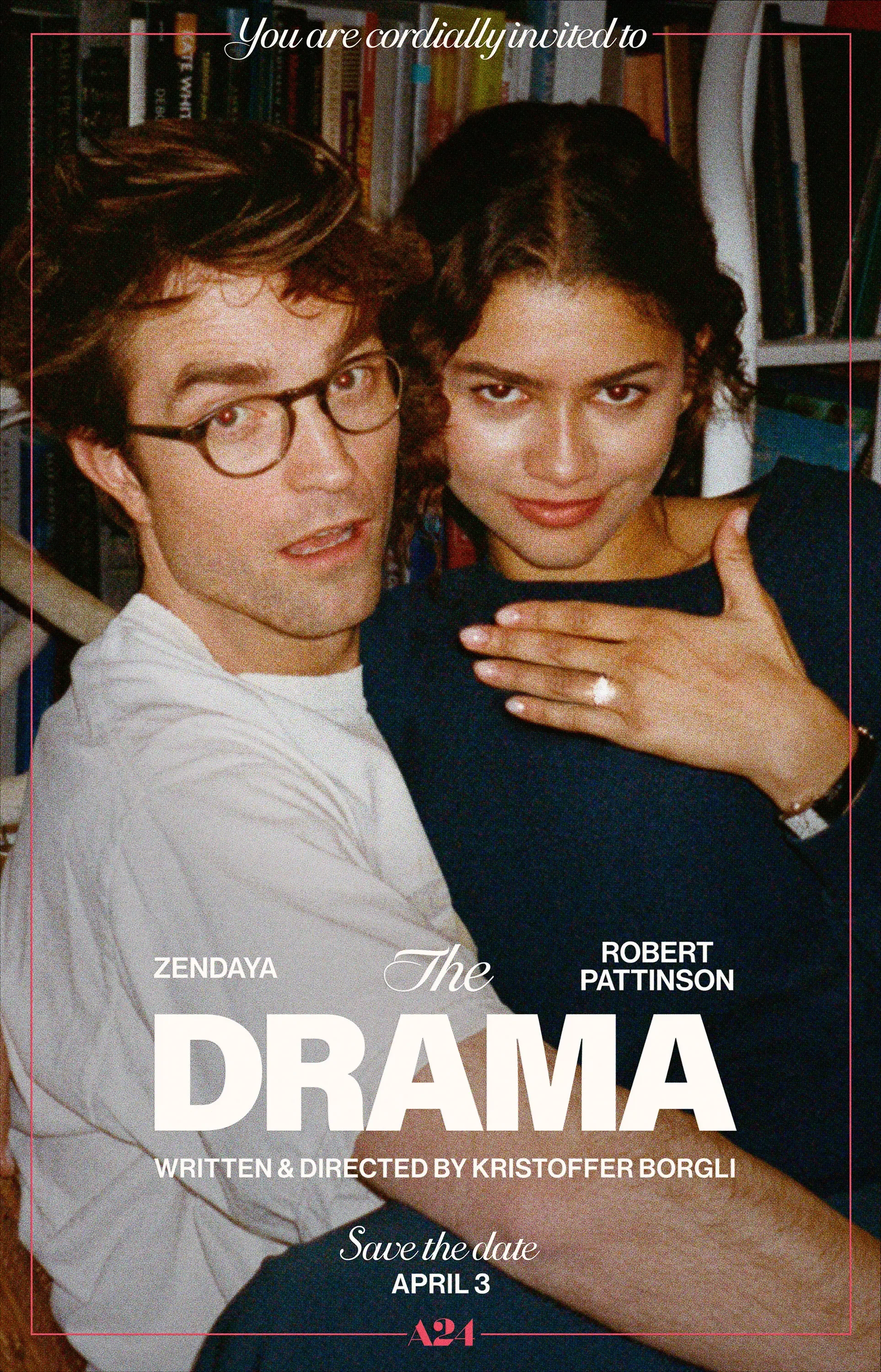
When the first trailers for The Drama released, I expected a sleek, high-stakes romance with wedding-day hurdles, but Kristoffer Borgli delivers something far more sinister. The film is less about a walk down the aisle and more about the slow-motion car crash of two people realizing they are marrying strangers. Zendaya and Robert Pattinson play Emma and Charlie. Their chemistry feels lived-in and authentic, making the subsequent unraveling genuinely uncomfortable. Borgli shows how intertwined yet separate their lives are as a couple and as individuals, and how their extended circle of friends impacts them through their opinions and thoughts.
The turning point occurs during a wedding catering tasting, which sets the car crash in motion. What starts as a game between the couple and their closest friends, Rachel (Alana Haim) and Mike (Mamoudou Athie), descends into a chilling competition of moral depravity. Here, Emma reveals her planned act of unthinkable violence. My biggest takeaway was Rachel's character. Haim plays her with a sharp, judgmental edge that encapsulates one of the film’s loudest themes: moral superiority as a weapon. Even when faced with her own past cruelty, Rachel uses her personal trauma to pivot into a position of high ground, "canceling" Emma within their own friend group. It shows how we use our moral compasses not to guide ourselves, but to look down on others, even when we have made hypocritical choices.
Emma’s history as a bullied newcomer seeking community in extremist online spaces offers compelling nuance. The movie explains the psychology behind why someone might commit such a dark act. But by ignoring the racial dynamics of Emma’s upbringing in a white-majority environment, the film highlights the 'blind spots' in Charlie’s empathy. He fixates on the shock of her actions rather than the context of her experience, reducing her history to a set of violent images he can't reconcile.
Charlie isn’t a saint either. He cyberbullied a classmate so viciously that he had to move. Charlie’s character is defined by a curated dishonesty that begins in the film’s opening frame. He lied about the book Emma is reading to strike up a conversation, setting a precedent for a relationship built on mirroring rather than authenticity. This small, early deception makes his later behavior, defending her actions to their friends while privately withdrawing his affection, feel like a natural extension of his need to maintain a 'perfect' public-facing persona at all costs. His fixation on Emma’s past eventually bleeds into his professional life, leading to an office affair.
The most unsettling part of Charlie and Emma’s relationship was the "re-introductions". Every time Emma attempts a reconnection, he says no. But when he initiates it, the relationship “resumes”. It could be a way to feel in control after learning something about his wife that she wanted to hide, and he doesn’t feel he knows her. The end of the movie shows that, after all the chaos of the wedding and everyone finding out about Charlie’s infidelity, they do a “re-introduction” and are “resuming” their relationship.
Personally, I would’ve called off the wedding, and everyone would be in therapy. But then, there would’ve been no movie. This movie highlights how people act in public vs. private, as well as the performance they put on to mask their inner feelings and true secrets they may regret. The Drama forces us to look at the masks we wear for our partners and asks a haunting question: If you truly knew everything about the person next to you, would you still choose them?
