A New “Melodie” for Slow Pulp
With a little over a decade since their first EP, Slow Pulp has just released their third studio album. The band is made up of childhood friends Alex Leeds (bass and vocals), Teddy Matthes (drums), and Henry Stoehr (guitar), with lead vocalist Emily Massey joining the band with the release of their second EP. Since the 2015 formation of the band, Slow Pulp has mostly stayed in the same genre of indie rock and folk, with some variation in terms of production as the band has developed further.
But Melodie, their latest album, has the potential to bring them into full indie superstar status. This isn't said to discredit the band, but many Slow Pulp fans were likely introduced to the project while they were opening for other acts. Slow Pulp has opened for elder statesmen of the indie rock and alternative scene like Death Cab for Cutie, the Pixies, and The Postal Service and also for more recent standouts like Alvvays, Ethel Cain, and Lucy Dacus. With a decent fanbase developed both from these touring shows and the strength of their own catalog, Melodie marks a turning point for the band. While the album is the band's second project with their label Anti-, it is the first album in the band's discography made by an outside producer (Elliott Kozel), though Stoehr and Massey were heavily involved in the production process. This change is definitely notable throughout the album, as while the foundational aspects of Slow Pulp is still there – acoustic guitar, occasional country instrumentation, shoegazey ambiance and noise – parts of the production on the album feel dialed up to eleven, though the album begins innocuous at first.
"Yellow and Green" is the opening track of Melodie, featuring Massey's standard dreamy vocals. It's a slower way to start the album and a great way to introduce the project to longtime listeners of Slow Pulp. The country influence in the band's music is obvious right off the bat, with the twang of "Yellow and Green's" backing guitars being the subtle difference between a straight acoustic guitar introduction and the rootsier sound of the song as a whole. The addition of tremolo strings in the background of the track, after the band has ramped up to punctuate Massey's vocals at the chorus, only add to this almost Midwestern evening feel. It's a fitting sound for a song that focuses on the blossoming of a relationship. Massey describes the nostalgia of being "Dumb and nineteen" in the song's first chorus, changing the line's age to thirty at the second chorus and ninety at the third. With an oak tree being the central meeting spot of the couple depicted in the song, the phrase "Yellow and Green" can easily be tied to the oak tree's changing leaves during fall. It's a sweet nostalgic ballad that many will relate to, likely reminiscing about someone they shouldn't be, and the perfect way to introduce listeners to the project.
There's an interesting mechanical sound at the beginning of "These Days" – maybe a tape rewinding or fastforwarding. It's quickly followed by more acoustic guitar, but the use of unconventional sounds will be a continuous thread across Melodie. A quick switch up lyrically from "Yellow and Green," this followup track is much more disillusioned. "Tell me how I'm supposed to feel, is this part of the city life?" Massey begins. While I mentioned that Slow Pulp was formed in Madison, Wisconsin, the band is now mostly based in Chicago. Yes, Illinois is undoubtedly part of the Midwest, but the 9.6 million population of the Chicago metropolitan area blows the Madison metropolitan area's 708k out of the water. Acoustic drudge is the most apt way to describe "These Days" and based on the song's lyrics, it might also be the best way to describe the band's move to Chicago. The track is upbeat enough that the song at least feels like it's progressing, but each acoustic guitar strum feels like Stoehr and Massey are playing through molasses. An excellent way to emphasize the song's lyrics without getting too fancy with production. Where "Yellow and Green" uses this same instrumentation and production to create something nostalgic and wistful, "These Days" swiftly turns these same tools and wields them to expertly depict depression, with the song's chorus succinctly summing up this feeling in four lines: "And what can I say? Another one of these days. It's sticking on the tip of my tongue, just floating in an empty tank." The song's lyrics and instrumentation go hand in hand to reinforce each other – a hallmark of good songwriting.
However, Melodie's third track blows the entire album out of the water. The album's lead single, "Better Man," explodes in a supernova of sound. "Yellow and Green" and "These Days" will not prepare you for this song, which sounds like it's off a different project. While there are pieces of "Better Man's" production that will continue to feature on the album, it is a bombastic way to debut this sound. In fact, I'd say there isn't another song that reaches both the volume and height of emotion like "Better Man" on Melodie. It absolutely makes sense why the track was picked as a single. There's only one warning of the anthemic roar of "Better Man," a single bell chime that rings out at the start of the track for about two seconds before repetitive drums, synth, and electric guitar, crash into your ear drums. It makes the slight break before Massey comes in to sing the first verse almost cathartic, as the steady beat ceases for Stoehr's guitar to take centerstage for a brief moment. The album's only music video (technically speaking, we'll get back to this) visually emphasizes all of these key instrumental moments. A match is struck at the same time as that introductory bell tolls. The lights flash on the beats of cymbal hits and guitar strums. Rain pours down on the band during the final shouts of the chorus. If "Yellow and Green" and "These Days" are proof that Slow Pulp knows how to combine lyrics, instrumentation, and production to all reaffirm each other, the video for "Better Man" proves that this awareness in creative direction extends to visuals as well.
Though comparison is the thief of joy, it might be wise to compare Slow Pulp's "Better Man" to Pearl Jam's iconic track of the same name. In the case of the grunge classic, Eddie Vedder describes a woman trapped in an abusive relationship who won't find someone better to take care of her. Slow Pulp, smartly, flips this theme on its head. Rather than being trapped in a relationship with another person, the protagonist of the Slow Pulp song is shouldering too much responsibility – "Cause I can hurt myself again, as I fade away from everything, and I hear a voice that's telling me to leave, leave it to me." The words "Leave it to me" are essentially the entire chorus of "Better Man," with that same thunderous drive punctuating Massey's vocals as she practically screams out the phrase. While, like with "These Days," the backing band and production team work hand in hand to emphasize the lyrics of "Better Man," Massey's voice and raw emotion truly is the song's emotional core. This is someone who is fed up. Someone who is exhausted. Someone who is bone-tired.
This is a feeling that most people can relate to. While I doubt the band was thinking about "Fleabag" at all, I can't help but to think of the confessional scene between Fleabag and The Hot Priest in the show's second season. Fleabag confesses to the ultimate sin – wanting someone to make choices for her. She wants someone to tell her what to do. What clothes to wear, what to eat, how to act. She would like a moment of respite. And while "Better Man's" protagonist is simply screaming for someone to shoulder her responsibility for a little while, the need for a small lack of agency in a world that preaches pulling yourself up by your bootstraps is certainly understandable. In fact, the song's first verse contends with the double-edge misogyny that presents itself in women's exhaustion, as Massey thinks that she should "Maybe leave it to a better man, who can tell himself this is how it's supposed to be." This is the conundrum of being a modern woman facing the growing tides of conservatism (see tradwives, see the AfD being elected in German, see, see, see…). With late state capitalism pushing the working class to its limit, the inherent emotional labor of being fem-presenting, and a struggling global economy, it's clear that women are fucking tired, man. "This is how it's supposed to be" – men are supposed to take care of women. That may have been the predominant belief of people for millenia, but not only have women fought for this belief to die, but it's inherently false. Women are capable of taking care of themselves, but is it anti-feminist to give up control momentarily? Are the only options women have exhaustion or patriarchy?

Photo by Luca Venter
My analysis of "Better Man" is probably so far removed from the central themes Slow Pulp was trying to tackle with the song that I probably seem like I traveled to Earth from Mars. Maybe the band just wanted to write a song about needing to unload responsibilities and have someone their to support you.But the best songs make you think. The best songs beg you to interact with the text and ponder them. Isn't it beautiful that a three minute track like this created a paragraph of questions? "Better Man" is a big swing for the band both lyrically and sonically. The band has played around with heavier moments before, like with the outro of "High" off their second EP and later on in Melodie, but "Better Man" isn't just the first instance of this sound on the album, it's the best version of it. If Slow Pulp played an entire concert where the set was just "Better Man," I would buy tickets for it. I would scream along every time. I would not walk out of that show with functioning vocal chords. "Better Man" dropped as a single in June and is on its way to hit 2.5 million streams on Spotify. Listen to the track yourself, it is the best part of the album by far.
Despite being so heavy, "Better Man" does end with a lighter electric guitar outro and one final ringing chord. It makes the raucous beginning of Melodie's title track all the more fun. This is a get up and dance song. While not a fully punk track, the guitar work on "Melodie" harkens back to the genre with little starts and stops for maximum head banging. When Slow Pulp goes on their North American tour next month, I wouldn't be surprised if "Melodie" is the track off this latest album that gets the crowd moving the most. It would not be surprising if the little "Uh's" before the second verse become a vocal chant from fans on this tour. Somewhat carrying on the lyrical themes of "Better Man," the title track focuses on self-destructive behavior, with Massey asking in the first verse "Did I miss out? I was indisposed, get my head out the gutter before I'm home." The song almost sounds like it would be played at whatever house party or show the track's protagonist was at the night before. Loud and messy and fun, with a great little instrumental break around the 1:30 mark that features an ear-wormy synth line. If "Better Man" shamelessly announced that heavy instrumentation is a part of Melodie, the album's title track showcases that this heavy instrumentation can be light and fun as well.
False-starting with a couple notes from bassist Alex Leeds, "Red Car" continues the heavy instrumentation featured on the last two tracks. The song's bassline is an anchor through the song, as the track weaves dense thrumming electric guitar and the occasional dazzling synth flourish. Massey's voice floats on top of the instrumentation, feeling almost detached (particularly on the chorus). It's a fitting creative choice for a song about wanting a new start. The only time Massey's voice is truly muffled is when she repeats "Start" on the song's outro, the band consuming the word. Another smart production choice from Kozel, Stoehr, and Massey.
After three loud rock tracks back to back, "Not for Nothing" is a well-needed break. Melodie's second single, the song's piano almost sounds distorted, like both the piano itself and the hammering of its strings were separately recorded and then mixed together. Picking this specific piano sound creates an older rootsier atmosphere – like the band sourced a piano from an abandoned church in the middle of the Appalachians. The banjo that swoops in at the instrumental break between the song's first chorus and its second verse cultivates this further. At the end of the day, "Not for Nothing" is a simple piano ballad. It's intimate and slow and almost cheesy in an 80's way (not full Michael Bolton). What you see is what you get, though the VCR static that punctuates the song's conclusion finally ties in with that mechanical sound featured in the introduction of "These Days."
Like "Red Car," "Entertainer" begins with a steady repetitive bassline from Leeds. The song's lyrics focus in on a romantic relationship yet again, though it's interesting that a song about not wanting to take someone back directly follows a track about needing to let someone go. Massey punctuates each chorus with the line "Classic entertainer," which could easily both describe the shitty partner who keeps worming their way back into Massey's life and the singer herself. The wry way she sings the line gives more credit to the former idea. Like "Better Man," the song ramps up at the chorus, though much more in line with the punk-adjacent energy of "Melodie." It's not a full kick in the pants, but it's a smart move by the band to ease back into rock instrumentation after a piano ballad like "Not for Nothing." Just like the aforementioned track, "Entertainer" also concludes with haunting fuzz and mechanical distortion. The only connective thread between the three tracks that have included this production ("These Days," "Not for Nothing," and "Entertainer") are that they all focus on some sort of sadness and depression. If intentional, this was a creative way to show how depression and disillusionment can be numbing. The steady thrum and buzz shown in these different sounds, and Melodie's instrumentation as a whole, builds a repetitive, almost inescapable, feeling.
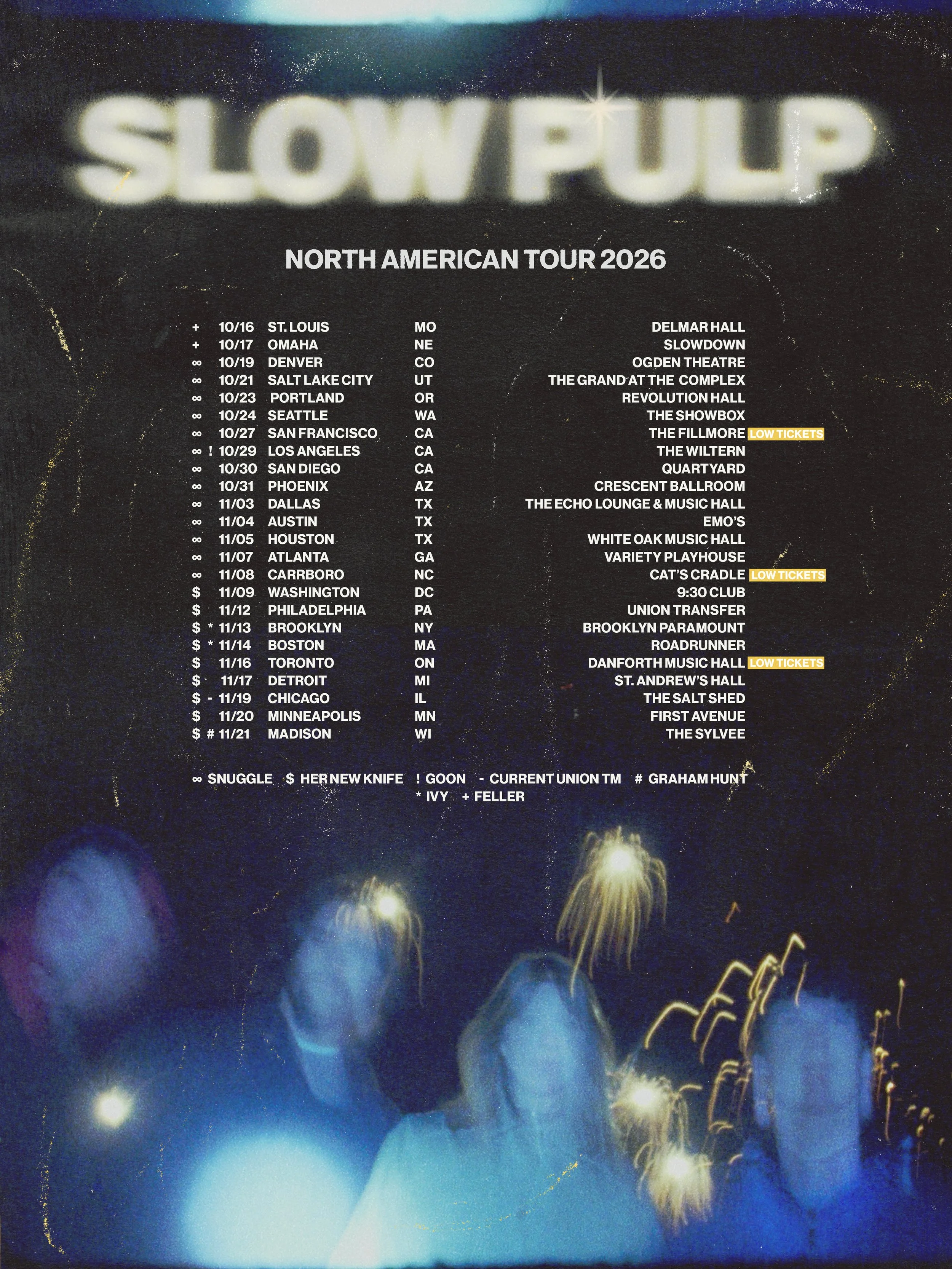
Poster for Slow Pulp’s 2026 North American Tour
But rather than beginning with old TV static, "Like Me" opens with a combination of buzzy static and instrumentation – distorted fuzz guitar. The track is sort of a culmination of all the disillusionment and intentional monotony featured on the album so far, taking an electric approach to the acoustic drudge of Melodie's first two tracks. There's something about the track that almost feels like a Deftones record, like the first half of "Rosemary." I’d heard some describe Slow Pulp as Shoegaze prior to this album, which never really clicked with me. “Like Me” finally made that connection click. The band still experiments with instrumentation, with some fun riffs at around 1:35 being the only added texture since the song began. It's the sort of track you'd want to listen to while being underwater in a bath tub, watching the way the sound waves of the song reverberate across the water. It may not be the flashiest way to highlight the band, but "Like Me" is definitely instrument forward, though Massey unleashes an incredible wail around 2:05. It's a fitting vocal embellishment for a song about realizing someone you used to have a crush on also had a crush on you. If this song came out while I was in middle school, I'd certainly be blasting it in my wired earbuds while riding the school bus. While I did say earlier while discussing "Better Man" that I wanted to hear Slow Pulp approach a heavier sound, I don't think "Like Me" should define this approach. I like the song, but it doesn't feel like the band as a whole. "Better Man" feels like an intersection between the folksier rootsier aspects of the band and this wall of sound production. Now that I've heard the heavy sound, it's definitely best to go the Goldilocks route.
"Spill" is the only other track on Melodie to have a video besides "Better Man." The video for the song isn't listed as a music video or a visualizer, though it would be fair to categorize its accompanying video as the latter as it mostly circles through various images. With lyrics like "Could you tell me you love me? Say it out loud, wanna find out." and the flipped lyric "Would you tell me that you love me?," "Spill" feels like the natural evolution of "Like Me." Rather than finding out that your crush liked you far too late, "Spill" lives in the feeling of wanting to know. Because this feeling inherently has some hope attached, "Spill" is more upbeat than "Like Me," though it's still fairly slow and subtle overall. Highlights include Massey's laugh before the guitar breakdown, the repeated guitar note in the song's conclusion, and its soft fade.
Beginning around the same tempo as its predecessor, "Up to You's" almost soupy guitars make sense for what I initially dubbed "anxious attachment: the song." Floaty ethereal backing non-lyrical vocals from Massey before she comes in with the chorus – "Cause I want it to last, is that all up to you?" – are an interesting touch that haven't really been explored outside of the reverby vocals on "Better Man." The song is much more about a one-sided break up and growing out of a relationship rather than anxious attachment, but it's an understandable first instinct if the chorus is the only lyrics one focuses on. Despite the many questions "Up to You" asks, it's lovely that the song ends with "I know I want you, to find me, where I am." It shows that while the song's protagonist truly wants their partner back, they are unwilling to give up who they are. The back half of the album touches on romance much more than the first half, though this choice, once again, may not have been intentional. Truthfully, it feels like the order of these tracks was curated so that listeners were not overwhelmed by all of the noisier tracks back to back.
Where "Not for Nothing" created a hollow ballad using piano, "Slip Away" does the same with guitar. Like the other tracks on Melodie, there are many different themes one could tie "Slip Away" to. There are some that could easily tie "slipping away" into relying on substances, as the protagonist of the song is clearly avoiding thinking about something. However, slipping away in this context could be as simple as being avoidant. It's an interesting lyrical theme to end the album with, but the volume and tone of the song make sense for a closer.
As a whole, Melodie is a good album that plays with interesting instrumentation and lyrical themes. It's a step in the right direction for Slow Pulp to expand the rock side of their sound, especially with a new producer on board. "Better Man" is undoubtedly a defining track in the band's discography. What influence or legacy the song has on the band has yet to be seen, but if there's any melody the band should chase, it's their latest lead single, not their latest album. Slow Pulp begins their North American in St. Louis on October 16. Catch them if you can!